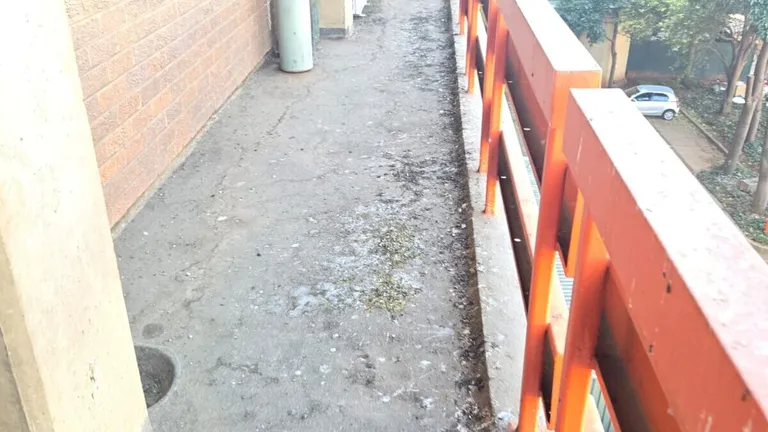
You’ve tried the plastic owl. You’ve tried chasing them. Maybe you bought spike strips from a hardware store. And the pigeons are still there.
That’s because getting rid of pigeons isn’t a product problem. It’s a biology problem. And until you understand why they keep coming back, nothing you buy will fix it.
Why pigeons keep coming back
Pigeons are creatures of habit. Once a pair picks a ledge, a roof void, or a balcony as a nesting spot, they come back to that exact spot. Over and over.
A single nesting site can produce several broods a year. The young birds settle nearby. So a small problem doesn’t stay small — it grows.
Buildings in Johannesburg are perfect for pigeons. Ledges and parapets mimic the cliff faces they naturally nest on. Rooftop equipment and solar panels give warmth and shelter. Nearby bins and food courts provide a reliable food supply.
Once a site is claimed, casual deterrents won’t shift them.
Why DIY methods fail
Most DIY pigeon deterrents fail for one of two reasons: they’re not strong enough, or they only cover part of the problem.
Plastic owls and scarecrows. Pigeons figure out they’re fake within days. A static object that never moves is no threat.
Reflective tape and shiny objects. Some short-term effect in open spaces. Useless against pigeons that are already nesting on a building.
Loose or cheap spike strips. Often installed with gaps, on the wrong surfaces, or without covering the full ledge. Pigeons are small. They find and use the gaps.
Chasing them or cleaning up. This addresses the mess. Not the birds. As long as the site is accessible, they’ll return.
The common thread: these methods treat the symptom (pigeons are here right now) rather than the cause (this site is accessible and attractive to pigeons).
What actually works
Professional pigeon control is about physically denying birds access to the site. Not scaring them. Blocking them.
Bird spikes. Properly specified and installed continuously along ledges, parapets, and signage. No gaps. No landing surface left.
Netting. Excludes birds from larger open areas — loading bays, atriums, parking structures, warehouse roof voids.
Mesh exclusion. Fine-gauge mesh around solar panels, roof edges, and equipment where birds nest underneath or behind fittings.
Surface modification. Sometimes the most effective fix is closing off or angling a surface so it’s no longer a viable nesting spot.
Which method works depends on the building. That’s why bird proofing isn’t a product you buy off a shelf — it’s a specification exercise.
What happens during a site assessment
When we assess a property for pigeon control, we look at where birds are roosting and nesting, how they’re getting access, and what’s attracting them.
We explain what we find in plain terms. No scare tactics. No vague promises.
We’ll be honest about timelines too. Existing nesting birds may take some time to fully relocate once a site is proofed. We don’t kill birds. We don’t use methods that breach bird-protection regulations. Our approach is safe and responsible bird management: exclude and deter, not eliminate.
The two-week follow-up
Every treatment includes a follow-up visit two weeks later. This is one of the most important — and most commonly skipped — steps in pigeon control.
We check that the proofing is holding. We catch anything birds have tried to work around. We make adjustments before a small gap becomes a new nesting spot.
Competitors who do a single visit and disappear are leaving that gap unchecked.
When to call a specialist
If you’re dealing with droppings building up on a ledge, birds nesting in a roof void, or noise and mess on a balcony or loading area — get a professional assessment before spending more on deterrents that won’t hold.
The earlier a site is properly proofed, the less damage and cleanup you deal with down the line.
Boya Pest Control has been proofing buildings against pigeons in Johannesburg since 2007. Every job includes a two-week follow-up to make sure the work holds. Contact us for a free site assessment and a clear, honest quote.